
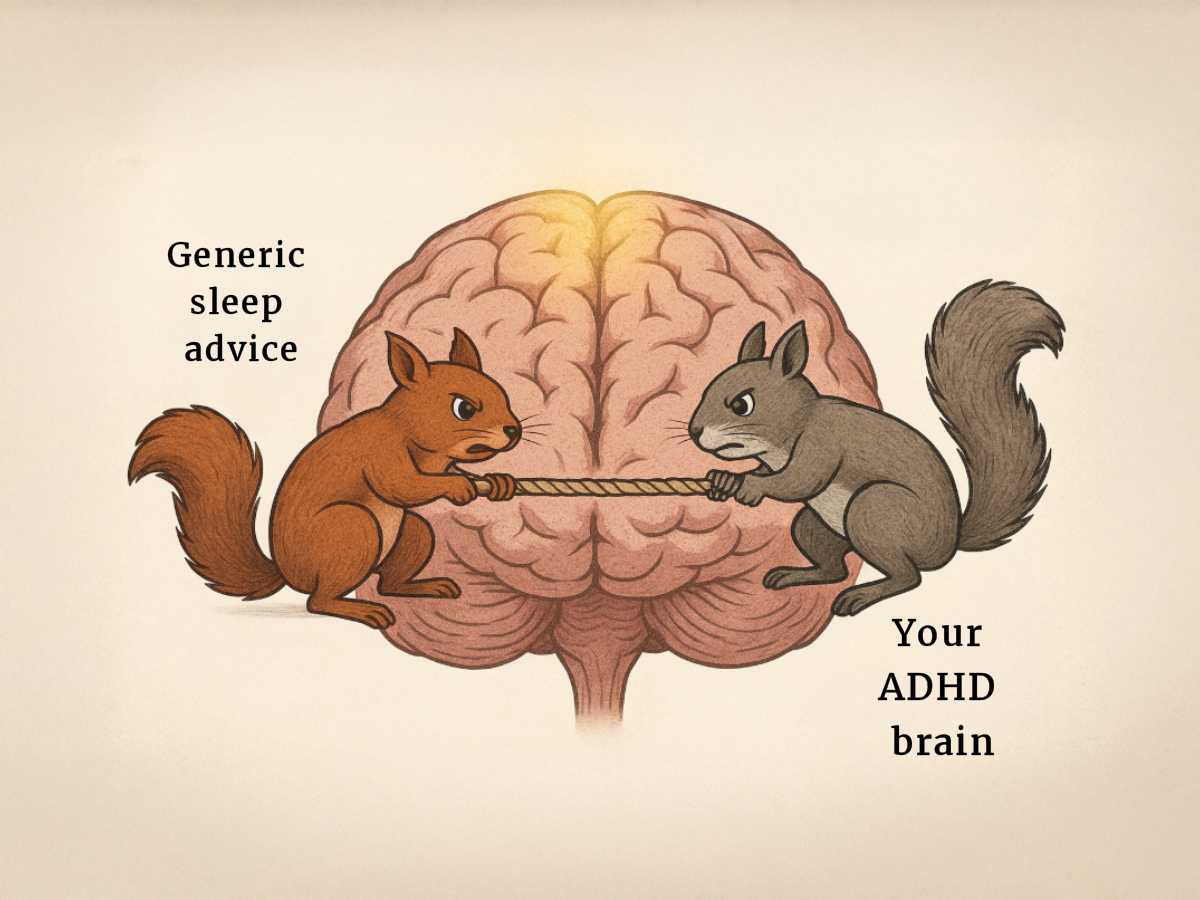
There’s a reason sleep deprivation is used as an interrogation tactic.
Sleep deprivation breaks people faster than almost any other torture method. Three days without sleep, and Navy SEALs start hallucinating. Five days, and prisoners confess to crimes they didn’t commit.
The CIA stops after 72 hours. Your ADHD brain has done 72 months.
If it’s effective enough to break enemy spies, what’s it doing to your Tuesday morning?
Nobody talks about this, but chronic sleep deprivation when you have ADHD isn’t just being tired. Your brain is a neurochemical warzone – dopamine reserves depleted, norepinephrine shells exploding. And that sleep advice everyone keeps giving you? It’s making everything worse.
Your brain on empty
ADHD sleep deprivation isn’t just fatigue. It’s your already-low dopamine crashing while norepinephrine floods the engine. This is why you’re simultaneously exhausted and vibrating.
When neurotypical people are sleep deprived, they get sluggish. When you have ADHD and you’re sleep deprived, you get wired.
You know the feeling. You’re exhausted but your brain won’t shut up. Your body feels like concrete but your thoughts are racing. You’re too tired to function but too revved up to sleep.
It’s like being drunk without any of the fun. Except you’re expected to perform at work, remember where you put your keys, and somehow not snap at everyone around you.
Why you can’t just push through
Here’s what happens when ADHD brains don’t get enough sleep. Your medication stops working properly. Not because you’ve built tolerance, but because sleep debt chemically blocks your meds’ efficacy. Adenosine builds up like chemical exhaust, clogging your brain’s dopamine filters so meds can’t do their job.
Your emotional regulation disappears. That thing where you can sometimes focus? Gone.
You’ve probably been told you just need better willpower. That you should try harder. That maybe you’re just lazy.
That’s complete nonsense.
Your brain isn’t broken. It’s stuck in a survival state that standard sleep advice worsens. Sleep deprivation crashes the part of your brain that manages everything else. It’s like trying to drive a car with a broken steering wheel while someone else controls the accelerator.
The vicious cycle nobody talks about
Sleep loss makes ADHD symptoms worse. Worse ADHD symptoms make sleep harder. Rinse and repeat until you’re lying awake at 3 am, wondering if this is just your life now.
But here’s the bit that’ll make you angry: standard sleep advice actually makes this cycle worse.
“Try going to bed at the same time every night.” Your brain produces melatonin two hours later than everyone else’s.
“Keep your bedroom quiet and boring.” Your understimulated brain interprets this as a threat and goes into hypervigilance mode.
“Practise relaxation techniques.” Your dopamine-starved brain rebels and starts calculating how many ceiling tiles you’d need to cover a football pitch.
The sleep industry has been accidentally torturing ADHD brains for decades.
Why ‘just sleep more’ is gaslighting
Most adults with ADHD have at least one sleep disorder. 40-60% of ADHD adults have delayed sleep phase disorder (Bijlenga et al., 2017). Our brains are biologically wired to sleep later and wake later.
When someone tells you your sleep problems are about discipline or habits, they’re basically saying your neurology is a character flaw.
Your brain isn’t broken. The advice is.
And now there’s proof. Research published in the BMJ this month involving 1,364 adults confirmed that ADHD sleep problems directly impact quality of life. The joint study between the Universities of Southampton and Amsterdam found that current clinical guidelines don’t typically recognise this connection. You weren’t imagining it – the link between ADHD and sleep problems is real and measurable.
Working with your brain instead of against it
ADHD brains don’t need stricter routines. They need different tools.
Your need for background noise isn’t bad hygiene. It’s sensory regulation. That 2am energy surge isn’t poor planning. It’s your natural rhythm. And racing thoughts aren’t overthinking. They’re your brain trying to process without enough support.
The Sleep Reset Kit is built around those realities. The Dimmer Switch Method™ acknowledges that ADHD brains don’t have an on/off switch. They need to gradually dial down the intensity of their dopamine requirement before sleep can happen naturally. The process starts an hour before bed and stacks a number of wind-down rituals that provide just enough stimulation. It works with your brain rather than against it. It even allows you to keep your phone on in your bedroom, as long as you’re standing up when using it (your brain associates posture with alertness, making it easier to disengage). This brain and body hack alone transforms your sleep routine and avoids the natural ADHD rebellion against “no phones in the bedroom” advice.
This gradual approach avoids cortisol spikes, unlike rigid stimulus control, which shows limited efficacy for ADHD adults (Schneider et al., 2020). Pair it with cognitive anchoring techniques, and you’re working with your biology, not against it. Anecdotal reports and early research suggest ADHD-specific techniques, such as cognitive anchoring, may help some people reduce sleep onset time. While individual results vary, the science is clear: when you work with your ADHD brain instead of against it, even minor improvements can feel life-changing.
The torture stops here
If anyone has ever called you lazy for struggling with sleep, remind them that sleep deprivation is classified as torture by international law.
You’re not failing at sleep. Sleep medicine is failing you.
You’re not broken. The system is.
The same medical establishment that prescribes amphetamines for focus won’t acknowledge your brain needs stimulation to sleep.
Ready for sleep advice that actually understands ADHD brains?
The cycle is real. But it’s beatable when you stop playing by rules that weren’t written for you.
These are tools designed for brains that don’t fit the system:
- Racing Thought Triage – cuts through the chaos that sleep hygiene ignores
- The Dimmer Switch Method™ – works with your brain’s refusal to obey arbitrary bedtimes
- Emergency hyperarousal resets – for when relaxation techniques backfire
- Dopamine hijacking – turns stimulation-seeking into wind-down momentum
➡️ What’s inside the ADHD Sleep Reset Kit™
➡️ Click here to visit our Homepage.
NEW – Take our free 3-minute quiz to discover your specific sleep disruption pattern – whether it’s circadian drift, rumination loop, task paralysis, sensory dysregulation, or hyperarousal. Receive strategies that work with your pattern and discover what doesn’t.
For ADHDers. By ADHDers. Backed by science, supported by lived experience, powered by hyperfocus. © Copyright 2025. All rights reserved.
Science hyperfocus section (for those who need the receipts)
The neurochemical reality: ADHD brains have 70% lower baseline dopamine transmission. Sleep deprivation further depletes prefrontal cortex dopamine, creating what researchers call a “double deficit effect.” Under sleep loss, ADHD brains show 300% more errors on cognitive tasks compared to well-rested controls (Schneider et al., 2020).
The hyperactivity paradox: Sleep-deprived ADHD brains show massive norepinephrine surges from the locus coeruleus, creating simultaneous exhaustion and hyperarousal (Berridge et al., 2012). fMRI studies reveal that ADHD prefrontal cortex activity drops below baseline under sleep deprivation, whilst amygdala hyperactivity increases (Ozel-Kizil et al., 2016).
Medication failure mechanism: Sleep debt increases adenosine buildup, which overwhelms dopamine transporters and blocks stimulant medication efficacy. This isn’t tolerance – it’s biochemical interference (Volkow et al., 2009).
Treatment failure statistics: Research shows CBT-I—the gold-standard insomnia treatment—fails ~60% of ADHD adults because it ignores our delayed circadian rhythms (Schneider et al., 2020). Forcing earlier bedtimes when melatonin isn’t ready? That’s like telling someone to fall asleep at noon.
Circadian biology: 40-60% of ADHD adults have Delayed Sleep Phase Disorder—meaning their melatonin releases ~1.5 hours later than neurotypicals (Bijlenga et al., 2017). Yet doctors still call this ‘poor sleep hygiene. This isn’t laziness—it’s biology. Genes like PER3 may contribute to ADHD circadian delays, but the system is complex (Coogan et al., 2017). One thing’s clear: You can’t ‘discipline’ your way out of a neurological difference.
Sleep disorder prevalence: ADHD adults face 3-10x higher DSPD rates, 2-5x more restless legs syndrome, and 2-4x higher sleep apnea risk—yet most are undiagnosed (Cortese et al., 2013; Surman et al., 2021)
Key citations:
- Berridge, C.W. et al. (2012). Biological Psychiatry
- Coogan, A.N. et al. (2017). Lancet Psychiatry
- Cortese, S. et al. (2013). Sleep Medicine
- Hiscock, H. et al. (2015). BMJ
- Hoxhaj, E. et al. (2018). Journal of Attention Disorders
- Ozel-Kizil, E.T. et al. (2016). Psychiatry Research
- Schneider, H.E. et al. (2020). Sleep
- van der Heijden, K.B. et al. (2019). Sleep
- Volkow, N.D. et al. (2009). JAMA
