
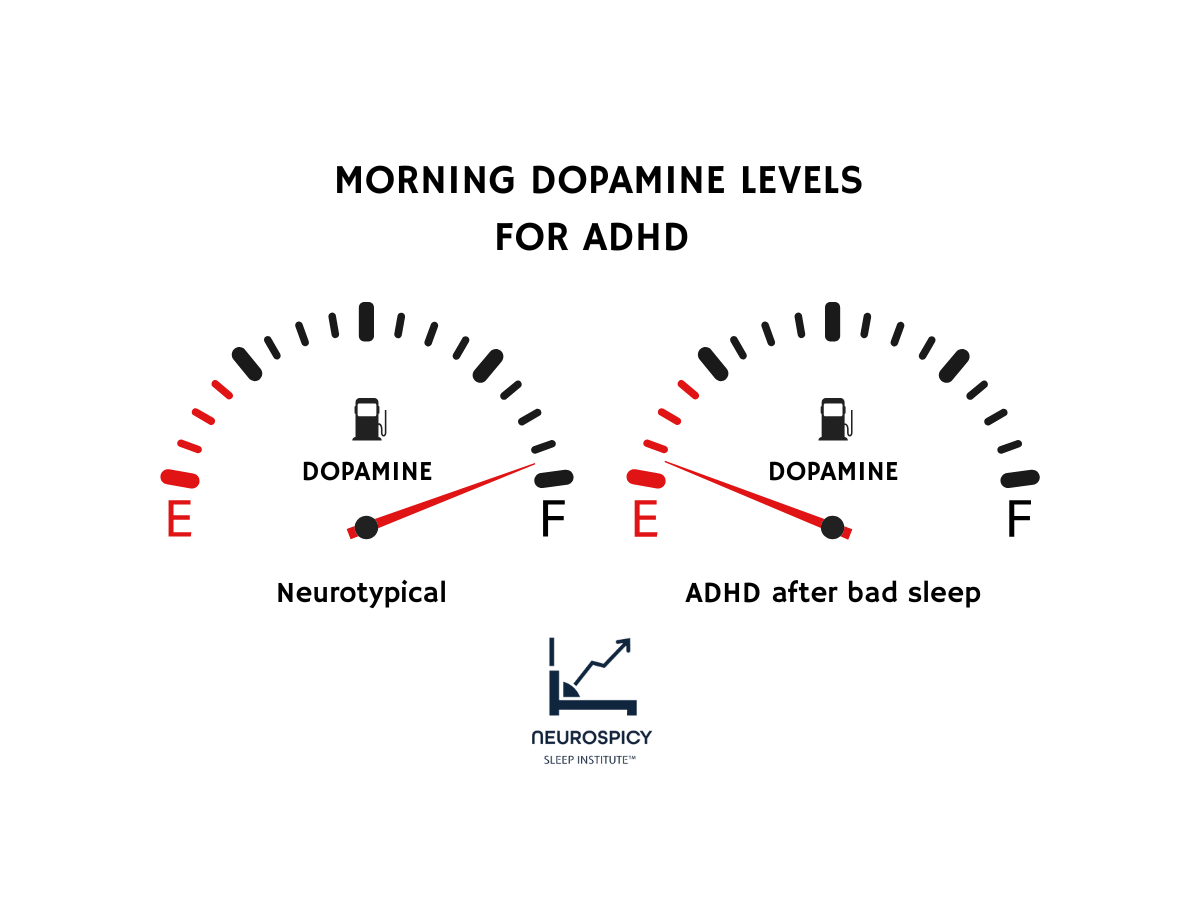
You know the difference between a good night and a bad night. After a decent sleep, your medication kicks in on schedule, you don’t need as much caffeine, interruptions feel manageable instead of catastrophic, and you can find your keys without having a breakdown about it. After a bad night, the same medication feels less effective, you are chasing dopamine, minor setbacks trigger stronger emotional reactions, and you lose three hours to a Wikipedia spiral about medieval farming techniques.
This morning condition isn’t just being tired. For many ADHD brains, sleep loss doesn’t make you sleepy so much as it amplifies the symptoms you’re trying to manage during waking hours.
The ADHD amplification effect
Research reveals something that neurotypical sleep advice often misses: sleep deprivation can affect ADHD brains differently than others. When neurotypical brains lose sleep, they typically get sluggish and move more slowly through their day. When ADHD brains lose sleep, core symptoms often become significantly more pronounced.
Adults with ADHD and insomnia show 2.5 times higher emotional dysregulation compared to those with ADHD alone. Gruber (2017, p.14) recorded ADHD+insomnia adults making 2.5x more task errors versus ADHD-only controls. This situation represents significant amplification, where symptoms become substantially harder to manage.
The mechanism helps explain why this happens for many individuals. Volkow (2009, Fig.3) shows 50-70% reduced dopamine receptor availability in ADHD prefrontal cortices compared to neurotypical brains. Sleep deprivation further depletes prefrontal cortex dopamine, creating what researchers call a “double deficit effect.” Your executive function was already working harder, and sleep debt makes the job considerably more difficult.
Why your medication may be less effective after poor sleep
Sleep debt doesn’t just make you tired. It can chemically interfere with your medication’s effectiveness. Poor sleep increases adenosine buildup in your brain, and adenosine can overwhelm dopamine transporters, potentially reducing how well stimulant medications bind. Note: Adenosine’s impact on stimulant efficacy is theorised from rodent studies (see review by Ferré, 2016) but has not yet been replicated in human ADHD trials. It makes sense, though, and is consistent with the NSI beta testers’ experience.
That’s why the same dose that helps you focus beautifully after good sleep may feel considerably less valuable after a bad night. Sleep debt also triggers norepinephrine surges from the brain’s arousal centres [Schneider, 2020, fMRI data on locus coeruleus hyperactivity in sleep-deprived ADHD adults], creating a common ADHD paradox: simultaneously exhausted and hyperalert, too tired to function effectively but too wired to rest.
It’s worth noting that some individuals with ADHD actually sleep better on stimulant medication due to paradoxical calming effects, and non-stimulant medications interact differently with sleep patterns.
Emotional regulation becomes more challenging
For many ADHD adults, emotional dysregulation becomes significantly more pronounced with sleep loss. Sleep-deprived ADHD brains show increased amygdala reactivity while prefrontal cortex activity drops, creating conditions where your emotional alarm system becomes more sensitive exactly when your ability to manage it is compromised.
This helps explain why sleep-deprived criticism feels more devastating, why minor disappointments may trigger stronger rejection sensitivity responses, and why you might snap at your partner over things that wouldn’t usually bother you. These emotional responses often reflect neurochemical consequences of sleep debt affecting an already-sensitive regulatory system, rather than character flaws or poor impulse control.
Individual responses vary considerably, and comorbid anxiety or depression can significantly complicate this picture.
Attention regulation becomes less predictable
ADHD attention already swings between hyperfocus and scattered states. Sleep deprivation often makes attention regulation more volatile and less responsive to conscious control.
When you’re well-rested, hyperfocus might engage with useful tasks for reasonable periods that you can eventually break out of when needed. When you’re sleep-deprived, hyperfocus may become less controllable and misdirected, leading to situations where you spend four hours reorganising digital photos instead of answering urgent emails.
The scattered state often becomes more pronounced, too, with time-blindness intensifying, working memory becoming less reliable, and that familiar experience of walking into rooms and forgetting why you’re there becoming more frequent. Sleep debt can turn inconsistent ADHD focus into something considerably more chaotic.
Stimulation-seeking behaviour often intensifies
Many tired ADHD brains don’t seek rest the way tired neurotypical brains do. They often seek dopamine through whatever means are readily available. Sleep debt can amplify the stimulation-seeking behaviour that keeps you scrolling at 2 am, eating junk food you don’t actually want, or engaging in unnecessary conflicts.
Your depleted dopamine system may interpret low stimulation as requiring immediate intervention through whatever means are available. This can explain why exhaustion sometimes leads to poor decisions that compound existing problems, or why you might stay up even later pursuing the stimulation your brain craves. This creates a cycle where poor sleep choices lead to worse sleep.
Physical health impacts may be more pronounced
The ADHD-sleep interaction extends beyond cognitive and emotional symptoms into physical health territory. ADHD populations already show higher baseline rates of certain health conditions including cardiovascular problems, metabolic dysfunction, and immune system variations. Sleep debt may accelerate some of these trends.
Some studies suggest that sleep-deprived ADHD adults show greater cortisol dysregulation, more inflammatory markers, and altered insulin sensitivity compared to neurotypical controls with similar sleep debt, though this research is still developing. The chronic physiological stress of managing amplified ADHD symptoms may create an additional burden that compounds direct sleep deprivation effects.
Recovery can be more dramatic
Here’s what standard sleep advice often misses: many ADHD brains don’t just need sleep more urgently; they also may recover from it more noticeably. When ADHD brains get adequate sleep, symptom reduction can be substantial and relatively rapid.
Medication effectiveness often returns to better baseline levels, emotional reactivity frequently decreases, focus becomes more manageable and predictable, and executive function usually improves significantly. One genuinely good night doesn’t fix everything, but the improvement can be noticeable enough that many ADHD adults become highly motivated about sleep once they experience the difference.
The flip side can also be pronounced. One abysmal night may destabilise several days’ worth of carefully managed routines and coping strategies. Sleep debt may accumulate faster in some ADHD brains and impact functioning more severely, though individual variation is considerable.
Why this matters for ADHD treatment approach
Understanding the amplification effect can change how ADHD treatment approaches are prioritised. Instead of treating sleep as a lifestyle factor to address eventually, it may be worth treating it as symptom management that makes other interventions more effective.
Research on specific circadian interventions (light therapy and melatonin protocols) shows that addressing ADHD sleep problems can reduce overall symptom severity by 22-27%. Some adults in these studies were able to reduce stimulant medication doses by 15% when sleep quality improved significantly through targeted interventions.
This suggests that sleep interventions might warrant earlier consideration in treatment planning, potentially before increasing medication doses or implementing complex organisational systems that require executive function that may be compromised by chronic sleep debt.
Sleep requirements may differ
For many ADHD brains, adequate sleep involves both quality and quantity considerations, and both may matter more than they do for neurotypical brains maintaining basic daily functioning.
Seven hours of fragmented, interrupted sleep typically won’t provide the symptom management that six hours of consolidated, uninterrupted sleep will deliver.
Most adults need between seven and nine hours of reasonably consolidated sleep to maintain baseline functioning. For ADHD brains, this requirement may be more critical because sleep debt amplifies symptoms more dramatically. However, any incremental improvement compared to your current sleep pattern is likely to be noticeable the following day, and these improvements build cumulatively over time.
Medication timing considerations
Sleep timing can affect not just whether your medication works optimally, but when it works most effectively throughout the day. Extended-release stimulants taken at 7 am might create rebound effects around 7 pm, potentially conflicting with naturally delayed circadian rhythms that need to start winding down for sleep.
Some ADHD adults find that splitting doses or switching formulations improves both daytime focus and nighttime sleep quality. Others benefit from timing medication schedules around their natural sleep-wake preferences rather than forcing sleep schedules around medication requirements.
This approach works best with prescribers who understand that ADHD sleep patterns represent genuine neurobiological differences rather than inconvenient side effects to work around.
Broader life impacts
The amplification effect often extends into life domains that may seem unrelated to sleep quality. Sleep-deprived ADHD adults frequently report more relationship conflicts, workplace difficulties, and financial problems, and this typically isn’t simply due to feeling tired.
Sleep debt can amplify the impulsivity, emotional dysregulation, and executive dysfunction that contribute to these broader challenges. Partners often learn to recognise the difference between well-rested and sleep-deprived ADHD behaviour patterns. Colleagues may notice connections between morning energy levels and daily performance patterns.
Sleep often becomes a significant determining factor in whether your day will be manageable or particularly challenging, regardless of planning or motivation levels.
Screening for sleep disorders
It’s worth noting that ADHD populations show significantly higher rates of sleep disorders, including sleep apnoea, restless leg syndrome, and circadian rhythm disorders. If sleep problems persist despite good sleep practices, screening for these conditions may be warranted, as treating underlying sleep disorders can dramatically improve both sleep quality and ADHD symptom management.
The practical approach
Understanding the amplification effect changes how to approach ADHD sleep problems practically. The goal isn’t about achieving perfect sleep or maintaining flawless routines every single night.
Instead, it’s about recognising that sleep quality significantly impacts symptom management, so improvements in sleep often translate to improvements in daily functioning. It’s about understanding that sleep difficulties and ADHD symptoms frequently interact rather than existing as separate problems.
The ADHD Sleep Reset Kit addresses this reality by focusing on the amplification effect rather than generic sleep improvement advice. It provides tools designed around the understanding that ADHD sleep needs often differ from neurotypical requirements and that improvements can have substantial impacts on daily functioning.
For many ADHD brains, sleep represents more than just rest. It’s often fundamental to the difference between symptoms being manageable challenges and overwhelming obstacles to daily functioning.
Get the ADHD Sleep Reset Kit
Also available: Sleep Apnoea Survival Kit for ADHDers who suspect breathing issues are making their sleep problems even more complicated.
***NEW – Take our free 3-minute quiz to discover your specific sleep disruption pattern – whether it’s circadian drift, rumination loop, task paralysis, sensory dysregulation, or hyperarousal. Receive strategies that work with your pattern and discover what doesn’t.
For ADHDers. By ADHDers.
Backed by science, supported by lived experience, powered by hyperfocus.
© Copyright 2025. All rights reserved.
Join the ADHD Sleep Facebook group
