
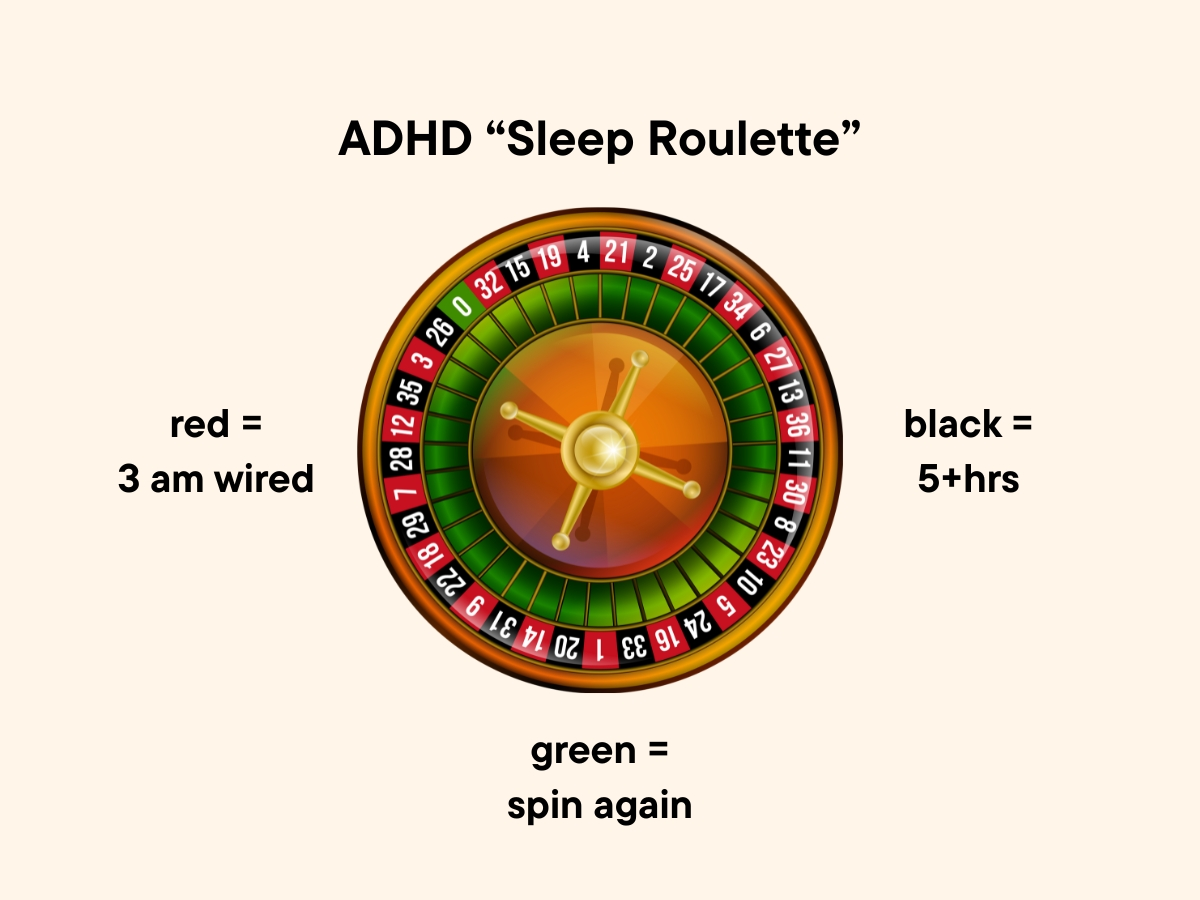
You went to bed at the same time. You followed the same routine. But last night you were out cold in ten minutes, and tonight, your brain is ranking biscuits and reliving an argument from 2009.
That’s sleep roulette.
It’s not that your tools don’t work. It’s that ADHD sleep isn’t consistent, even under controlled conditions. The outcome shifts from night to night, even when nothing else seems to change. That unpredictability is a defining feature, not a personal failure.
Here’s what’s really happening.
The sleep system isn’t just delayed. It’s unstable
Many ADHDers have a delayed circadian rhythm. But more importantly, the rhythm itself is fragile.
Your body clock isn’t just behind schedule. It’s inherently unstable (Bijlenga et al., 2017: ADHD circadian rhythms are 1.5x more disrupted by light/stress). Minor changes in light exposure, stress, or evening activity can shift melatonin onset by hours. What worked yesterday might be too early or too late tonight. This isn’t just sensitivity. It’s circadian fragility.
Executive function doesn’t reset evenly
On high-executive-function days, you might manage your evening well. On low-function days, bedtime tools get skipped, cues get missed, and impulse control drops.
You know you should dim the lights, close the tabs, and start winding down. But you’re still on a group chat at midnight, and you forgot to drink water. That’s not sabotage. That’s state-based regulation failure.
The routine didn’t fail. The system running it did. And that system is unpredictable by design.
Dopamine controls the gate, then changes the rules
Dopamine affects both sleep timing and reward-seeking. Low baseline levels mean sluggish days but restless nights (Volkow et al., 2009: 70% lower nighttime dopamine in ADHD). Your brain overcompensates by chasing stimulation, overriding fatigue.
That’s why some nights you feel tired and settle. Other nights, you scroll for an hour and suddenly start reorganising your desktop folders at 1am.
The signal for rest isn’t strong enough. The signal for reward takes over.
Emotional load lingers longer than you think.
ADHD brains don’t just feel more. They carry more emotional residue into the night.
Stress, overstimulation, or excitement create neurochemical hangovers. Cortisol stays elevated. Stress leaves ADHD amygdala 30% more reactive (Ozel-Kizil et al., 2016), prolonging nighttime alertness. Glutamate keeps the brain alert. These block natural sleep signals, sometimes for hours after the event.
Even on calm days, your emotional system might not wind down at the same rate as your body. And you won’t know until you try to sleep.
The nervous system is wired for unpredictability.
The system that governs calm and alert states isn’t steady either. ADHD is often linked to autonomic nervous system dysregulation.
Some nights, the switch flips into rest mode. Other nights, stress leaves you wired but not tired. Or your body feels exhausted, but your mind keeps pacing. You can’t predict which version you’ll get.
Interoception keeps the feedback loop broken.
Sleep relies on being able to sense when it’s time. Many ADHDers struggle to notice internal cues like fatigue.
You might feel jittery, but assume you’re still alert, or mistake agitation for energy. Interoceptive gaps make it harder to trust your own signals. That disconnect leads to sleep attempts that are often mistimed.
It also means you don’t build consistent feedback from routines. What worked last night may feel irrelevant today. Each night becomes a reset, not a pattern.
When routines stop working, it feels personal.
Most people are told to fix their sleep with routines. ADHD adults try them, too. But when a routine fails on day three, it doesn’t just feel annoying. It feels like a verdict.
You did everything right, and still ended up doom-scrolling at 3.17am.
Repeated failure breeds conditioned sleep anxiety. Your brain starts to associate bedtime with stress. That triggers hyperarousal before you’ve even tried to sleep. The result: another bad night, and even more frustration.
How to rig the odds
You can’t eliminate randomness. But you can reduce the stakes.
The Dimmer Switch Method™ was designed with this in mind. You don’t try to hit sleep all at once. You lower the intensity in stages. That includes mental noise, environmental friction, and emotional residue. You decide what feels possible tonight, not what worked yesterday.
This method works because it bypasses executive overload, allowing for a gradual energy reduction that aligns with your current capacity.
It’s not a rulebook. It’s a system you can shape around chaos.
Final thought
ADHD sleep is not about discipline or compliance. It’s about probability.
If sleep feels like roulette, you’re not alone. The system wasn’t built for consistency. But with the right tools, you can stop betting blind.
Not every night will go your way. But they don’t all have to.
Stack probability, not perfection.
Ready for sleep advice that actually understands ADHD brains?
The cycle is real. But it’s beatable when you stop playing by rules that weren’t written for you.
These are tools designed for brains that don’t fit the system:
- Racing Thought Triage – cuts through the chaos that sleep hygiene ignores
- The Dimmer Switch Method™ – works with your brain’s refusal to obey arbitrary bedtimes
- Emergency hyperarousal resets – for when relaxation techniques backfire
- Dopamine hijacking – turns stimulation-seeking into wind-down momentum
➡️ What’s inside the ADHD Sleep Reset Kit™
➡️ Click here to visit our Homepage.
NEW – Take our free 3-minute quiz to discover your specific sleep disruption pattern – whether it’s circadian drift, rumination loop, task paralysis, sensory dysregulation, or hyperarousal. Receive strategies that work with your pattern and discover what doesn’t.
For ADHDers. By ADHDers. Backed by science, supported by lived experience, powered by hyperfocus. © Copyright 2025. All rights reserved.
