
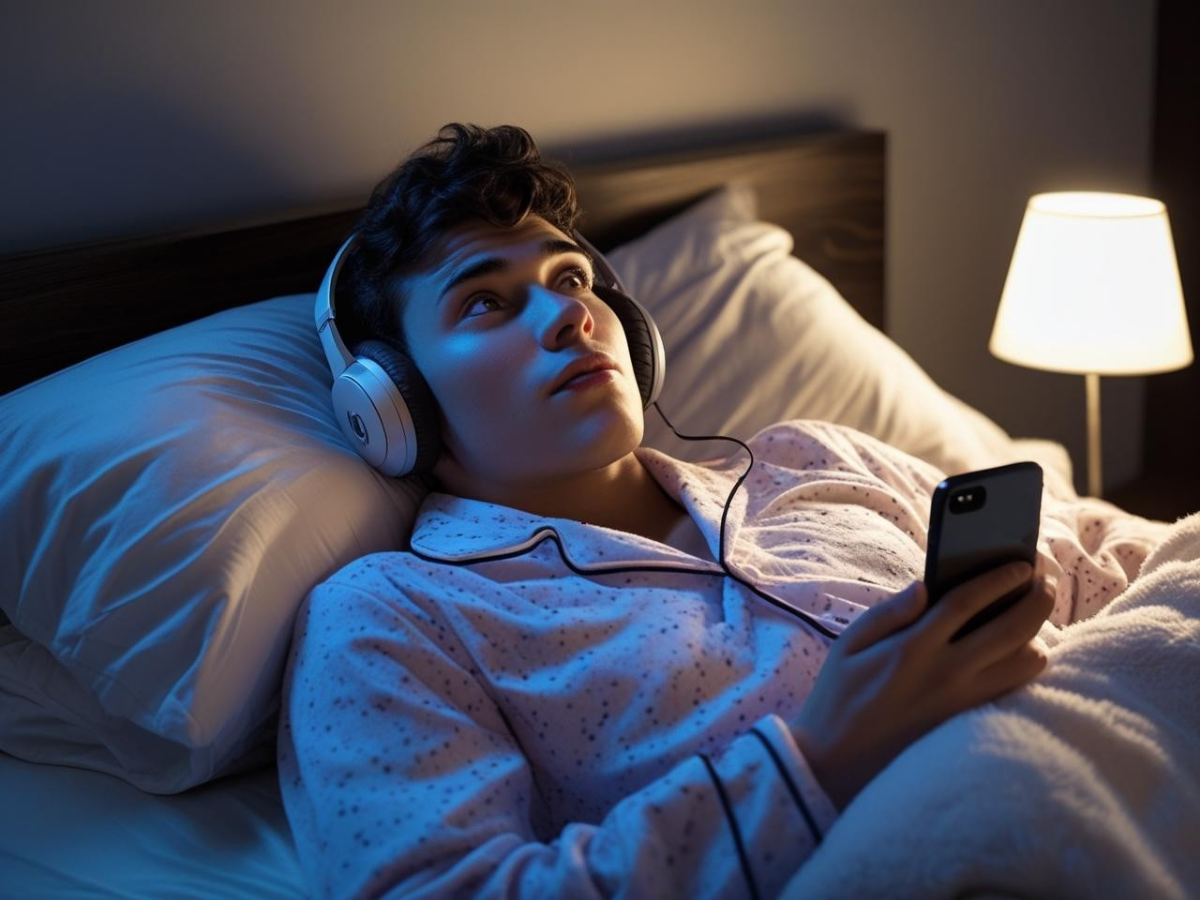
If you have ADHD and your Spotify likes are full of sleep playlists that worked exactly once, maximum 3 times, this is for you.
You’re not playlist-hopping because you’re picky. Your brain isn’t broken. It’s responding exactly as ADHD brains do: seeking novelty, resisting boredom, and reacting to mismatch. You’re searching for something that doesn’t exist: audio that can fix a transition problem.
The playlist graveyard effect
Your music library tells a familiar story. “Deep Sleep Sounds”. “ADHD Sleep Music”. “Calming Nature Mix”. Each one promised to be the answer. Each one worked for maybe three nights before your brain decided it was either boring, annoying or somehow making things worse.
Here’s the thing: if sleep playlists actually worked for ADHD brains, there wouldn’t be thousands of them on Spotify.
Think about it like walking into a pharmacy. You’ll find maybe three types of effective painkillers, but thirty different cough medicines. Why? Because painkillers actually work. Cough medicines… not so much.
Sleep playlists are the cough medicine of the audio world. The endless variety exists because none of them solves the real problem.
What’s really happening
You’re trying to use step five to solve a step one problem.
When your brain is in hyperarousal mode, racing thoughts bouncing around like pinballs, adding more sensory input rarely helps. You’re asking audio to do work that needs to happen before you even think about music.
ADHD brains don’t just need different sounds. They need a different approach entirely.
The transition problem
Research shows ADHD is increasingly understood as a 24-hour disorder, not just a daytime challenge. Your brain doesn’t respond well to strict on/off instructions. Telling your system to “just go to sleep now” is like slamming the brakes on at 70mph.
Sleep doesn’t start with sleep. It starts with transition.
Your brain state when you hit play determines everything. Racing thoughts, sensory overload, that “tired but wired” feeling? No playlist will touch those. You need to address the pre-conditions first.
What to try instead: the dimmer switch approach
Instead of hunting for magic audio, treat wind-down like a dimmer switch. Lower the intensity gradually, staying in control.
Before you even think about playlists:
- Racing thought triage (3 minutes max): Dump everything swirling around your head onto paper. Don’t organise, just empty it out. Thoughts need somewhere to land so they stop circling.
- Dopamine wind-down wheel: Your brain doesn’t hate routine, it just hates boring ones. Pick one low-stimulation activity that feels doable tonight. Maybe organising your desk drawer, doing a word search, or sorting through old photos.
- Light transition cues: Set an alarm for one hour before you want to try sleeping. When it goes off, dim the lights. This gives your brain advance warning.
Now audio can actually help:
Once you’ve done the prep work, your nervous system is ready to benefit from audio. We’ve created our own ADHD sleep playlists based on what works for our beta clients, but they’re designed to be used after the transition work, not as a substitute for it.
Our playlists work because we understand they’re one piece of a larger puzzle:
- Consistent tempo and volume (no jarring transitions that hijack attention)
- Familiar but not exciting (your brain can predict without analysing)
- Themed for different ADHD minds (some need nature sounds, others prefer instrumental music)
- Matched to your prep work (different playlists for different pre-sleep states)
The difference isn’t better music. It’s knowing when and how to use audio effectively.
The bottom line
If you’re still collecting sleep playlists after reading this, try the racing thought triage first. Three minutes, one page, no pressure. See if that changes how audio affects you.
We’ve been adding some of our own favourite nightime sounds on Spotify in a series entitled “Neurospicy does …”. They are not an instant cure, nor are they miraculous in any way to any others you might find, but they are sounds that work for us and our beta testers within the context of an overall toolkit.
Remember, when fixing your sleep, you are not collecting gold stars. You’re finding what actually works for your specific brand of nighttime brain chaos.
Finally, sleep advice that doesn’t make you feel broken.
Backed by peer-reviewed studies showing that traditional sleep tests miss ADHD-specific dysfunction and that circadian strategies alone can reduce symptom severity by up to 27%.
Refer to our comprehensive research foundation for sources and summaries.
Ready for sleep advice that actually understands ADHD brains?
The cycle is real. But it’s beatable when you stop playing by rules that weren’t written for you.
These are tools designed for brains that don’t fit the system:
- Racing Thought Triage – cuts through the chaos that sleep hygiene ignores
- The Dimmer Switch Method™ – works with your brain’s refusal to obey arbitrary bedtimes
- Emergency hyperarousal resets – for when relaxation techniques backfire
- Dopamine hijacking – turns stimulation-seeking into wind-down momentum
➡️ What’s inside the ADHD Sleep Reset Kit™
➡️ Click here to visit our Homepage.
NEW – Take our free 3-minute quiz to discover your specific sleep disruption pattern – whether it’s circadian drift, rumination loop, task paralysis, sensory dysregulation, or hyperarousal. Receive strategies that work with your pattern and discover what doesn’t.
For ADHDers. By ADHDers. Backed by science, supported by lived experience, powered by hyperfocus. © Copyright 2025. All rights reserved.
